
My snow finally melted off the mountain this week. Every year the sun comes back and I think I was doing fine, and then I feel real sun on my face and I’m like, oh right, this is what fine actually feels like. There’s a version of that for our work too. We think we’re doing fine until something reminds us what fine is supposed to feel like.
That’s part of why I started this series on lessons from the natural world. We have all of these blueprints in other species, in our world, of things that work. Reciprocity, balance, collaboration, the values we say we want our work to live out are already being lived out, every day, in the natural world.
This episode is about the Three Sisters. Maybe you know them already. Corn, beans, and squash, planted together in the same mound. At least 3,000 years of Indigenous agricultural technology, and one of the most elegant arguments for collaboration I’ve ever come across.
A quick refresher on who’s who
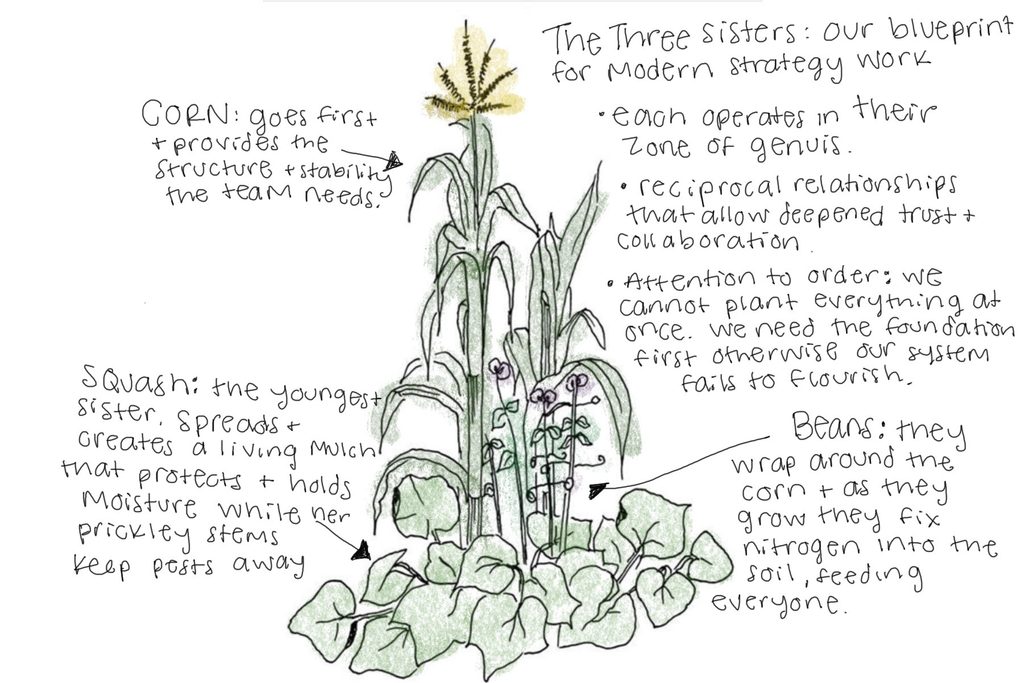
Corn is the eldest. Corn goes in the ground first. She grows tall and gives the beans something to climb. The beans are the giving middle sister. They wrap around the corn, and as they grow they fix nitrogen into the soil, which feeds everyone, themselves included. The squash is the youngest sister. She spreads along the ground, creates a living mulch that holds moisture and suppresses weeds, and her prickly stems keep pests away. From dandelions to groundhogs, the squash is on defense.
Together they’re more space-efficient, more drought-resistant, and more nutritionally complete than any one of them planted alone. Corn brings carbohydrates but lacks the amino acids. Beans bring the protein. Squash brings vitamins, minerals, and healthy oils. None of them is the whole meal, but together they are.
Different nations adapted the technique to local climate and conditions. The Haudenosaunee approach is not the Pueblo approach is not the Lakota approach. The same wisdom is reshaped by place.
So what does any of this have to do with strategy?
So much. Honestly, so much.
First, the Three Sisters are a strengths-based collective. Corn provides structure. Beans nourish. Squash protects. They are not all doing the same thing at the same table. And yet the system thrives because each one is contributing exactly what it’s built to contribute. That’s what the best collaborations look like. Each partner in their zone of genius, doing what only they can do, trusting the others to do the same. When organizations try to do everything themselves, they end up doing nothing well, and they certainly aren’t in service of the communities they came here to serve.
Second, the relationships are reciprocal rather than extractive. The beans don’t just climb the corn and take. They feed the soil that feeds everyone. The squash doesn’t just shelter under the older sisters. She protects them. This is the difference between extractive storytelling, where you take the story, use it for the campaign, and move on, and ethical, deep listening that builds trust while it surfaces strategy and grows a community’s own narrative capacity at the same time. I have come into so many organizations and somehow seen them figure out a way to do storytelling without listening. We never want that in the room. Story is infrastructure, and the gathering of it has to feed the ecosystem it came from.
Third, and this is the hardest one for me to embody, sequence matters. You cannot plant everything at once. Corn first. Then beans. Then squash. In strategy work, that’s the visioning session before the strategy. The deep listening before the design. The trust before the program build. I have watched so many organizations skip the corn phase and then wonder why their strategy plans sit on shelves. The structure has to go in first. Then the soil gets nourished by the listening. Then the protection comes in, in the form of programs and decisions that hold what you’ve learned.
Fourth, no single crop has everything you need. There’s no single organization, no single campaign, no single initiative that’s going to feed a community completely. A two-legged stool tips over. We need the third partner, the third strength, the third contribution. Collaboration is a nutritional requirement.
And finally, the Three Sisters are humbling. Three thousand years of agricultural technology refined by people paying attention to what actually works. Story-driven strategy is learning from what already knows how to thrive. Clever ideas have nothing to do with it. We can’t out-design this. We’re not smarter than the communities we work in. We are the communities we work in, and our job is to understand them well enough to do the work we came to do.
A few questions to sit with
What is your organization extracting from communities right now, and what is it returning to the soil?
In your current collaborations and partnerships, are you the corn that provides structure, the beans that nourish, or the squash that protects? And inside your own organization, is one team the corn, another the beans, another the squash?
As you build strategy and programs forward, are you planting in the right sequence, or are you trying to do everything at once?
Who’s who shifts over time, which is part of the magic. You’re not permanently the corn. You’re holding it down for a season, and then someone else picks it up and you get to be in your bean phase for a while. That’s how living systems work.
If a Story Lab Session is calling to you as you read this, I’ve got a few left on the calendar before the mid-year mark. You walk away with the corn part of your work done. Structure, insights, a roadmap built on what you actually have. And from there you can move into the bean and squash of it.
Thanks for being here.
Entangled Health can be in your ears, too! Listen to the show wherever you tune into podcasts.
What the Three Sisters know about strategy that we keep forgetting

